
Designing stellarators with a generative model#
This tutorial generates a stellarator boundary with the Diffusion baseline of the paper’s inverse-design task: a generative model that draws boundaries with the properties we ask for.
Install the package with its models:
pip install "boss-bench[models]"
Now download and load the model using the convenience functions from boss-bench:
from boss_bench import models
from boss_bench.models import InverseDesignModel

path = models.download("inverse_design", "BoSS-models/inverse_design")
model = InverseDesignModel.load(path)
The conditions#
The model is conditioned on properties the design should have, given by the names of
BoSS fields and in their units: the number of field periods nfp, the loss_fraction
of the alpha particles born on \(s = 0.1\), the toroidal flux toroidal_flux_edge, the
minor_radius, the aspect_ratio, the minimum field strength min_modB, the
mirror_ratio, the pressure and iota profiles, and vmec_ncurr, a boolean which
says whether the equilibrium is computed with the \(\iota\) (0) or the current profile (1).
Good designs come from realistic conditions with a low loss fraction. We use the
conditions of devices from the test set with a low loss fraction. Download
confinement_data_test_split_00000.hdf5 from the Download Data page
into a folder, here BoSS/, and take the conditions of the first stellarator of the
test split that loses less than 10% of its alpha particles:
import h5py
import numpy as np

import boss_bench as bb

path = bb.list_files("BoSS", "confinement", "test")[0]
with h5py.File(path, "r") as f:
    for i in range(len(f["uuid"])):
        lost = bb.load_record(f, i, ["confinement_time", "t_max", "s_init"])
        loss_fraction = bb.loss_fraction(
            lost["confinement_time"], lost["t_max"], lost["s_init"], s0=0.1)
        if loss_fraction < 0.1:
            break
    record = bb.load_record(f, i)

conditions = {}
for name in models.inverse_design.CONDITIONS:
    if name == "loss_fraction":
        conditions[name] = loss_fraction
    else:
        conditions[name] = record[name]
    print(f"{name}: {np.round(conditions[name], 3)}")
nfp: 2
loss_fraction: 0.001
toroidal_flux_edge: 70.581
minor_radius: 2.184
aspect_ratio: 10.0
min_modB: 4.642
mirror_ratio: 1.148
pressure: [0. 0. 0. 0. 0. 0. 0. 0. 0. 0. 0. 0. 0. 0. 0.]
iota: [0.402 0.402 0.402 0.401 0.401 0.401 0.401 0.4   0.4   0.4   0.4   0.399
 0.399 0.399 0.399]
vmec_ncurr: 1
Generate and plot a design#
sample() generates a
boundary with these properties, laid out as the field boundary_xyz. Each call with
another seed draws another design:
design = model.sample(conditions, seed=0)
plot_device() draws it over the full torus. A generated
boundary has no \(\lvert B \rvert\) until its equilibrium is computed, so it is colored by
the height \(z\) of its points and shaded:
generated = {name: record[name] for name in ("nfp", "phi1d", "theta1d")}
generated["boundary_xyz"] = design
bb.plot_device(generated)
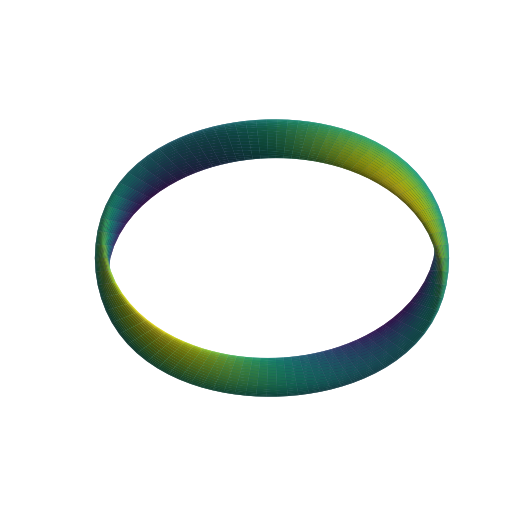
To ask for a different design, change the conditions, for example a lower
loss_fraction. To check a design, compute its equilibrium with VMEC and trace its
alpha particles; the inverse-design benchmark, design_metrics(),
scores designs evaluated this way.